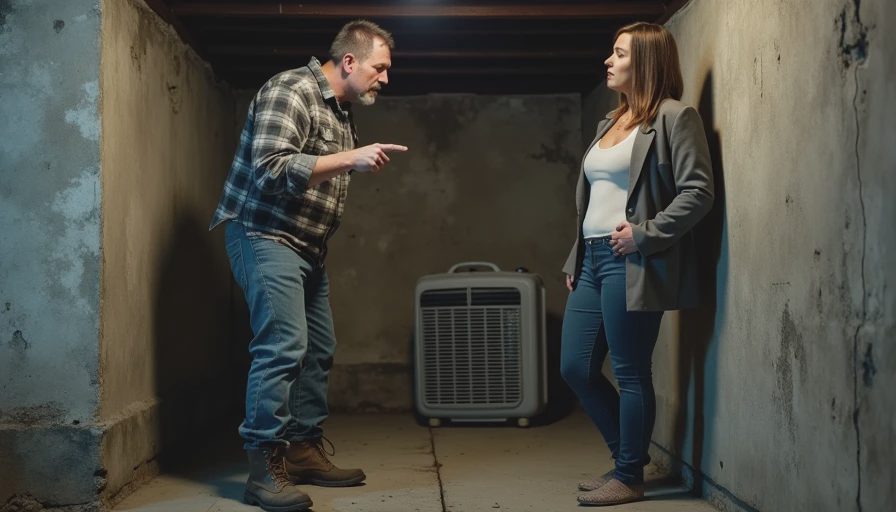
I’ve sat in hundreds of living rooms while a contractor points at a basement wall, shakes his head slowly, and says something like:
“Well… this is worse than I expected. You’ve got some real structural concerns here. We should open it up and take a look.”
And I’ve watched the homeowner’s face change. The shoulders drop. The eyes go wide. Suddenly they’re not thinking about money. They’re thinking about their house falling down.
That’s fear. And fear is the most expensive tool in a contractor’s truck.
Now, let me be clear: most contractors are honest, hard‑working people. I’ve hired many of them. But the home repair industry runs on a simple economic truth: the more urgent you feel, the more you’ll spend.
And in an old house, there’s always something that looks scary.
So how do you talk to contractors without letting fear hijack your budget? You go in with a plan, a script, and a clear understanding of what’s actually an emergency. Here’s exactly what I’ve learned.
The three words that protect your wallet
Before you call anyone, memorize this phrase:
“Let me think about it.”
Not “yes.” Not “let me check with my wife” (though that’s fine too). Just: “Let me think about it.”
A good contractor will respect that. A pushy one will try to make you feel like you can’t wait. That’s your signal to slow down even more.
I’ve never, not once, seen a situation where a homeowner needed to sign a contract within 24 hours to avoid disaster. House problems are almost never that urgent. The ones that are (gas leak, active electrical fire, collapsed ceiling) you already know about.
Everything else can wait a week.
Start with your own triage before you call

Contractors are in the business of selling solutions. That’s fine. But you need to know what problem you’re actually trying to solve before you let them propose a $20,000 fix.
Before you pick up the phone, write down:
What is the actual symptom? (Not “the foundation is failing.” But “there’s a crack in the basement wall that weeps water after heavy rain.”)
How long has it been this way? (If it’s been there for eight years, it’s not an emergency.)
What have you already tried? (Cleaned gutters? Extended downspouts? Added a dehumidifier?)
What outcome do you want? (“Stop the water from coming in” is different from “make the basement fully finished and dry.”)
When you have those four answers, you’re ready to call. You’re not an expert, but you’re not a blank check either.
The first phone call: what to ask and what to hide
When you call a contractor for a quote, they’ll usually ask a few questions to size you up. Here’s how to answer without painting a target on your budget.
What they ask: “What’s your budget for this project?”
What you say: “I’m in the information‑gathering stage right now. Can you give me a rough range based on the problem?”
Do not give a number first. If you say “around $5,000,” the quote will magically come back at $4,800 or $7,000. If you say “I don’t know, what’s fair?” you’ll get a number based on what they think you can afford, not what the job actually costs.
What they ask: “Have you had anyone else look at it?”
What you say: “Not yet. I’m getting a few opinions.”
This tells them you’re shopping around. That keeps pricing honest. Never hire the first contractor who walks through your door.
What they ask: “How soon do you need this done?”
What you say: “I’m flexible. What’s your typical timeline?”
Do not say “as soon as possible” or “it’s been leaking for a while and we’re worried.” That’s fear talking. Be calm. Be vague.
During the walkthrough: watch for the fear script

I’ve heard the same phrases over and over. They’re designed to make you feel like your house is special — and special usually means expensive.
Fear script 1: “I’ve never seen anything quite like this.”
Translation: “You can’t compare my price to anyone else because this is unique.”
Reality: They’ve seen it before. Old houses all have similar problems. Ask: “What’s the most common fix you do for this kind of issue?”
Fear script 2: “If we don’t address this now, it could lead to structural failure / mold / health problems.”
Translation: “I’m introducing a worst‑case scenario to make the smaller fix feel cheap.”
Reality: Almost nothing in an old house goes from fine to catastrophe without years of warning signs. Ask: “On a scale of 1 to 10, where 10 is ‘the house is unsafe tonight,’ where is this right now?” A honest contractor will say 3 or 4. A fear‑seller will say 8 or 9.
Fear script 3: “We won’t know until we open it up.”
Translation: “I’m about to charge you for exploratory demolition, and I have no idea what the final price will be.”
Reality: Sometimes that’s true. But a good contractor can give you a range and a best‑case / worst‑case scenario. Ask: “What’s the most likely thing we find? What would make the price go up? What would make it go down?”
Fear script 4 (the classic): “You get what you pay for.”
Translation: “My high price is justified by quality, and anyone cheaper is cutting corners.”
Reality: Sometimes true, but often just a way to dismiss competition. Ask: “Can you show me an example of a similar job you did at a lower price point?” Or just get three quotes and compare scope, not just numbers.
The single most powerful question you can ask
After the contractor finishes their walkthrough and before they hand you a number, ask this:
“If this were your house and you had to live with it for another year without spending a lot, what would you do?”
This question does three things:
It tells you what’s actually urgent vs. cosmetic.
It separates the honest advisors from the salespeople.
It gives you a free, no‑pressure plan you can implement yourself.
I’ve asked this question dozens of times. The good contractors pause, think, and give me a real answer: “Honestly? I’d fix the gutter outside and see if that stops the water. The crack itself isn’t moving. You’ve got time.”
The sales‑driven contractors get uncomfortable. They say things like “Well, I wouldn’t feel comfortable leaving it that way” or “I can’t recommend anything less than the full repair.”
That’s your answer. Move on to the next quote.
How to compare three quotes without losing your mind
Always get at least three quotes for any job over $1,000. But comparing them is hard because they’ll all describe the work differently.
Here’s a simple system:
Step 1: Normalize the scope
Write down what each contractor proposed. Do they all agree on what the problem is? If one says “replace the whole window” and two say “repair the sash and add weatherstripping,” the first one is selling you a different product. Don’t compare the price until the scope matches.
Step 2: Look for the middle
Throw out the highest and lowest quote. They’re outliers for a reason — one is overpriced, one is missing something. The real price is usually in the middle.
Step 3: Ask about exclusions
“What’s not included in this price?” Some contractors leave out disposal, permits, or cleanup. That $3,000 quote might become $4,500 when you add those back.
Step 4: Trust the person, not just the price
Did they show up on time? Did they explain things clearly? Did they try to scare you? Did they answer your questions without getting annoyed? You’re going to have this person in your house. Cheap is not worth a bad experience.
A real example from a family I worked with
Last year, a mom with two kids called me about a wet basement. She’d had one contractor come out. He told her she needed interior drain tile, a sump pump, and a full waterproofing system — $14,000. He said if she waited, the foundation would start to fail.
She was terrified. She almost signed.
I told her to get two more quotes and ask my magic question: “If this were your house, what would you do for a year?”
The second contractor came out, looked at the wet corner, and said: “Your downspout is dumping water right against the foundation. Move it ten feet away. Clean your gutters. Then see if it’s still wet. I’ll come back for free in three months.”
She did that. Cost: $40 in downspout extensions. The basement dried up. She never needed the $14,000 system.
The first contractor wasn’t lying — his system would have worked. But it was a sledgehammer when she needed a flyswatter.
When fear is actually justified
I don’t want you to think I’m telling you to ignore real problems. There are times to act fast:
Carbon monoxide (detector going off? Evacuate, call fire department, then an HVAC pro)
Active gas leak (smell gas? Leave the house, call utility)
Sewage backing up into basement (health hazard, call plumber immediately)
Structural collapse (ceiling sagging badly, wall bowing more than 1–2 inches)
Everything else — lead paint, asbestos, old windows, damp basements, cracks in foundation, old wiring — is almost never an overnight emergency. You have time to get multiple quotes, ask questions, and sleep on it.
A script for saying no
If a contractor makes you feel pressured, here’s exactly what to say:
“I appreciate you coming out. I’m not ready to make a decision today. I’ll review your proposal and get back to you within two weeks.”
If they push back: “I understand you’re concerned. I’m going to get a second opinion before I move forward. That’s just how I make decisions.”
Any contractor who gets angry or pushy after that is someone you don’t want in your house anyway.


No feedback yet — submit the first.