I want to start with something important: you cannot identify asbestos just by looking at it. Not definitively. The only way to know for sure is lab testing.
But after hundreds of inspections in homes built between 1920 and 1980, I’ve learned that asbestos has signatures. Certain textures, certain locations, certain materials that should make you stop, pause, and say: “That might be asbestos. Let me treat it that way until I know for sure.”
This article is not a DIY testing guide. It’s not permission to rip anything open. It’s an education tool — so you can recognize what might be asbestos in your own utility space, understand why it looks the way it does, and know exactly what to do next.
No panic. Just knowledge.
Why mid-century utility spaces are ground zero
From about 1940 to 1980, asbestos was a miracle material. It was cheap, fireproof, insulating, and durable. Builders put it everywhere you wouldn’t see — especially in basements, crawlspaces, attics, and mechanical rooms.
Utility spaces are where the furnace, boiler, water heater, pipes, and electrical panels live. These areas were never meant to be pretty. They were meant to be functional. And functional, in the mid-century, meant asbestos.
So if your house was built between 1940 and 1980 (or had original mechanical systems into the early ‘80s), your utility space likely contains at least one asbestos-containing material. That doesn’t mean you’re in danger. It means you need to know what you’re looking at.
Six common faces of asbestos in utility spaces
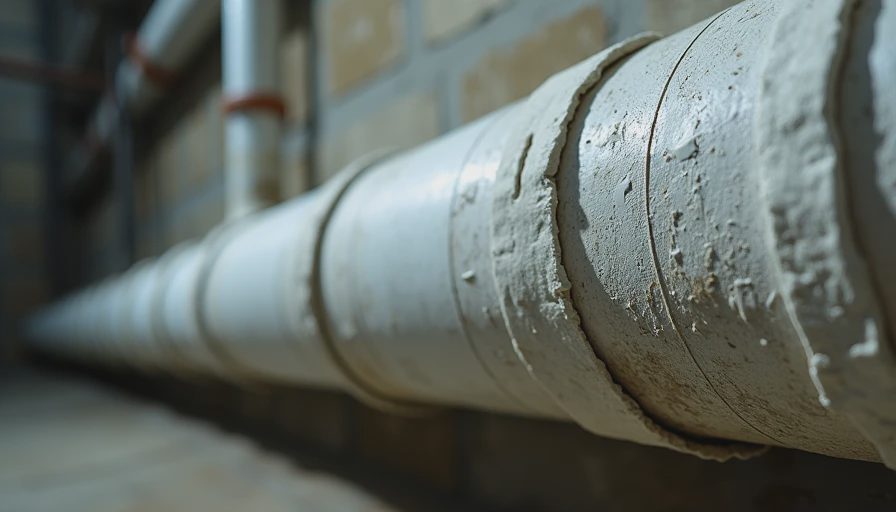
1. The white or gray pipe wrap that looks like corrugated paper or stucco
This is the most famous asbestos material for a reason.
What it looks like: A thick wrap around pipes, usually 1–2 inches thick. The surface is often white or light gray. It can look like:
Corrugated cardboard wrapped around the pipe (this is “air-cell” insulation)
A smooth, hard plaster-like coating (this is “mud” or “hard cast”)
A crumbly, chalky white material that flakes when touched
Where to find it: Steam pipes, hot water pipes, heating ducts. Often in basements or crawlspaces, running from the boiler to radiators or registers.
The danger level: High if it’s crumbling (friable). This material releases fibers easily. Do not touch, bump, or go near it with a broom.
What to do: Leave it alone. If it’s intact and not shedding, many homeowners encapsulate it (wrap it in special fabric or spray it with a sealant). But that’s a pro job. If it’s damaged, call an asbestos abatement contractor. Don’t DIY.
2. The fibrous blanket wrap around old boilers and furnaces
What it looks like: A thick, off-white or gray blanket wrapped around the body of an old boiler, furnace, or water heater. It often has a canvas or paper outer layer that’s falling apart. Underneath, you might see a fluffy, fibrous material that looks like matted cotton.
Where to find it: On the sides and top of old heating equipment, especially units from the 1950s–70s that haven’t been replaced.
The danger level: Very high. This material is almost always friable. The fibers are loose and release easily.
What to do: Do not brush against it. Do not store boxes near it. If your boiler or furnace looks like this, start planning for replacement. A modern, efficient unit won’t have asbestos. And the abatement can happen as part of the replacement. This is not a DIY removal situation.
3. The 9x9 or 12x12 floor tiles that are brittle and dark
What it looks like: Vinyl asbestos tile (VAT) or asphalt asbestos tile. Usually 9×9 inches, though some are 12×12. Colors are often dark — black, dark brown, dark gray, or mottled tan. The tiles may be brittle, cracked, or missing pieces.
Where to find it: Basement floors, utility room floors, older laundry rooms. Sometimes under a layer of carpet or newer vinyl.
The danger level: Low to moderate. The asbestos fibers are bound in the vinyl or asphalt. They don’t easily become airborne unless you sand, grind, or break the tiles aggressively.
What to do: If the tiles are intact, leave them alone. You can put new flooring over them (floating floor, new vinyl, even carpet). Do not sand, scrape, or use a floor grinder. If you must remove them, hire a professional. In many places, it’s legal for a homeowner to remove VAT with proper wet methods, but I don’t recommend it unless you’ve been trained.
4. The textured ceiling that looks like cottage cheese or popcorn
What it looks like: Spray-on acoustic ceiling texture. It can be heavy, bumpy, and soft-looking. Sometimes it’s been painted over multiple times. Colors range from white to cream to off-white, often yellowed with age.
Where to find it: Basement ceilings, utility room ceilings, sometimes in attached laundry or storage rooms. Popcorn texture was used from the 1950s through the 1980s.
The danger level: Low unless disturbed. The asbestos (usually 1–5% chrysotile) is mixed into the texture compound. It’s not friable on its own, but scraping, sanding, or drilling into it releases fibers.
What to do: Do not scrape it. Do not drill into it to hang a light fixture without testing first. If it’s in good condition, the simplest thing is to leave it alone or cover it with drywall (encapsulation). Removal is expensive and messy. Most of the time, you don’t need to remove it.
5. The corrugated cement panels behind or around equipment
What it looks like: Gray, rigid sheets that look like a cross between cardboard and concrete. They often have a wavy or corrugated pattern. The surface is rough, almost stony. Sometimes they’re painted gray or silver.
Where to find it: As a heat shield behind a wood stove or old boiler. As a panel on the back of an electrical panel door. As a liner in an old furnace room.
The danger level: Moderate. The asbestos is bound in cement, so it’s not friable unless the panel is broken, cut, or drilled. But cutting or breaking it releases fibers aggressively.
What to do: Leave it intact. Do not drill or cut it. If it’s in your way, call an abatement contractor to remove it. Do not break it into pieces to fit in a trash bag.
6. The gray or white fibrous “mud” around pipe penetrations
What it looks like: A gray, grainy, or fibrous putty-like material stuffed around holes where pipes go through walls, floors, or ceilings. It can look like dirty plaster or old cement with fibers sticking out.
Where to find it: At the point where a pipe enters a wall or floor. Around electrical conduit penetrations. Around ductwork joints.
The danger level: Moderate to high. This “mastic” or packing material can be very crumbly. It was often applied as a paste that hardened over time. When it dries out and cracks, it releases fibers.
What to do: Do not poke it. Do not try to remove it. If it’s crumbling and in an area you use, consider having it professionally wetted and removed or encapsulated. Often, simply sealing over it with spray foam (after testing) is acceptable, but check your local regulations.
What asbestos does NOT usually look like
To help you avoid false alarms, here are things that look scary but are usually not asbestos:
Fiberglass insulation (yellow, pink, or white, fluffy like cotton candy) — this is fiberglass, not asbestos
Rock wool (dark gray or brown, chunky, like shredded cardboard) — not asbestos
Cellular foam pipe insulation (black or gray foam, rubbery) — not asbestos
Modern drywall and joint compound (post-1985) — not asbestos
Concrete blocks — not asbestos
If you see these, you can breathe easier. But if you’re not sure, treat it as suspect until proven otherwise.
The three rules I give every homeowner
After I show a family what asbestos looks like in their utility space, I give them three rules. I’ll give them to you too.
Rule 1: If it looks like it might be asbestos, don’t touch it.
No sampling with a pocketknife. No “I’ll just scrape a little bit.” No sweeping up dust from a crumbling pipe. Asbestos fibers are microscopic. You can’t see when you’ve disturbed them.
Rule 2: Don’t panic — most asbestos in good condition isn’t an emergency.
The families who scare themselves the most are the ones who believe every asbestos sighting means cancer tomorrow. That’s not true. Intact, non-friable asbestos materials pose almost no immediate risk. The danger is from long-term, repeated exposure to airborne fibers — usually from renovation work, not from looking at it.
Rule 3: Test before you renovate, disturb, or remove.
If you’re planning to:
Tear down a wall
Replace a ceiling
Remove old floor tile
Change out a boiler or water heater
Scrape a popcorn ceiling
Drill into a cement panel
Stop. Test first. Home test kits are available for $30–$50. Or hire an inspector to take samples. The cost is tiny compared to the risk of releasing asbestos into your whole house.
What we have in our house
I’ll be honest with you. Our 1948 basement has 9×9 floor tiles in a mottled tan and black pattern. I assume they contain asbestos. We don’t walk on them much. We keep a dehumidifier running. One day we’ll cover them with a floating floor. We will never, ever sand them.
Our old boiler was replaced by the previous owner. I’m grateful. The old one almost certainly had asbestos blanket wrap. I never had to deal with it.
Our basement ceiling is not popcorn. But the utility closet has a gray corrugated panel behind the electrical panel. I had it tested. It’s asbestos-containing cement board. It’s in good shape, no cracks. I’m leaving it alone.
That’s not lazy. That’s risk management.
When to call a pro
Call an asbestos abatement contractor if:
Pipe wrap, boiler wrap, or furnace wrap is crumbling, torn, or hanging down
A material you suspect is asbestos has been damaged by water, a leak, or accidental impact
You need to remove or drill into a suspect material as part of a necessary repair
A contractor you’ve hired wants to “just take care of it” without testing (run from that contractor)
Do not try to remove friable asbestos yourself. It’s not about bravery. It’s about containment, negative air pressure, HEPA filtration, proper disposal, and not contaminating your entire house. Professionals have training and equipment you don’t. That’s okay.





No feedback yet — submit the first.